
The stamping die manufacturing process is a key part of modern metal forming production. A high-quality stamping die directly affects product accuracy, production efficiency, tooling cost, and service life.
From automotive parts and electronic components to appliances and industrial equipment, stamping dies are widely used in mass production. A complete stamping die manufacturing process involves several important stages, including stamping die design, material selection, precision machining, assembly, testing, and quality inspection.
Each step plays an important role in ensuring that the final stamping die delivers stable performance and reliable production results.
Stamping Die Design: The Foundation of Precision Manufacturing
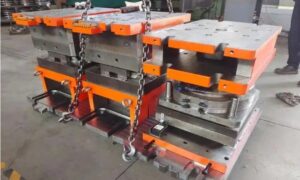
The stamping die design stage is the first step in the entire manufacturing process and determines the basic performance of the final tool.
Before designing a stamping die, engineers need to understand the product requirements, including part structure, material characteristics, production quantity, accuracy requirements, and stamping methods.
Different products require different die structures. For example, large sheet metal components may require progressive dies or deep drawing dies, while small precision parts may require high-accuracy stamping dies.
During the design process, engineers need to consider factors such as material flow, die strength, punch and die clearance, production efficiency, and maintenance requirements.
A well-designed stamping die can reduce problems such as cracking, deformation, excessive burrs, and unstable forming during production, while improving product quality and tool life.
CAD Design and Simulation in Stamping Die Manufacturing
With the development of digital manufacturing technology, CAD design and simulation have become important parts of modern stamping die manufacturing.
Engineers use 3D design software to create accurate models of stamping die components, including punches, dies, guide systems, and other precision parts.
Before actual production, simulation technology allows manufacturers to analyze the stamping process and identify possible problems, such as material wrinkling, forming cracks, stress concentration, and improper clearance.
By optimizing the design in a virtual environment, manufacturers can reduce trial production costs and shorten development time.
For complex stamping products, CAE simulation technology can help predict material deformation behavior and optimize forming parameters, ensuring better production efficiency and stable product quality.
Stamping Die Materials: The Key to Durability and Performance
The selection of stamping die materials has a direct impact on die life, wear resistance, and production stability.
Because stamping dies operate under high pressure, repeated impact, and continuous friction, the material must provide excellent hardness, toughness, and fatigue resistance.
Common stamping die materials include Cr12MoV tool steel、D2 tool steel、SKD11 tool steel、tungsten carbide.
Different materials are suitable for different production requirements. For example, standard stamping applications may use tool steel with good wear resistance, while high-volume production often requires materials with higher hardness and longer service life.
The final material selection depends on factors such as production quantity, stamping material, product accuracy, and working conditions.
Heat Treatment and Surface Treatment of Stamping Dies
After selecting the proper die material, heat treatment and surface treatment are applied to further improve stamping die performance.
Heat treatment improves hardness, strength, and resistance to deformation. Common processes include vacuum heat treatment、quenching and tempering、annealing treatment.
Surface treatment helps reduce friction, improve wear resistance, and extend die service life. Common technologies include TiN coating、TiCN coating、TD coating、chromium plating、nitriding treatment.
These treatments are especially important for high-speed and high-volume stamping production where dies experience continuous wear.
Stamping Die Manufacturing: From Material Preparation to Precision Machining
After completing the design and material selection, the stamping die enters the manufacturing stage.
The first step is raw material preparation. High-quality die steel is selected according to design requirements and processed to improve dimensional stability.
Precision machining is the core part of stamping die manufacturing. Modern manufacturers use advanced CNC equipment and high-precision machining technology to achieve strict tolerances.
The main machining processes include CNC milling、wire EDM machining、grinding、heat treatment.
CNC milling is mainly used for machining complex die structures and precision surfaces. Wire EDM is suitable for producing complex shapes and high-precision components. Grinding improves surface finish and dimensional accuracy, while heat treatment enhances hardness and wear resistance.
Through advanced machining processes, manufacturers can produce stamping dies with high precision and long service life.
Stamping Die Assembly and Debugging
After machining, all stamping die components must be carefully assembled and adjusted.
Important components include punches、dies、guide pillars、guide bushings、stripper plates、positioning parts.
Precision assembly ensures correct alignment between punch and die, proper clearance, smooth movement, and stable production performance.
Even a small assembly error can cause problems such as uneven wear, poor product accuracy, and reduced die life.
After assembly, the stamping die enters the testing and trial production stage.
Engineers check product dimensions, surface quality, burr conditions, forming accuracy, and die operation stability.
If any problems are found, adjustments are made to the die structure, clearance, or stamping parameters until the final product meets production requirements.
Quality Control in Stamping Die Manufacturing
Quality control is an essential part of the entire stamping die manufacturing process.
During production, manufacturers use advanced inspection equipment such as coordinate measuring machines (CMM)、optical measuring instruments、hardness testers、surface roughness testers to verify accuracy and performance.
Strict quality inspection ensures that the stamping die can provide:
- Stable product quality
- Lower scrap rates
- Longer service life
- Higher production efficiency
Every stage, including design, material selection, machining, assembly, and testing, must be carefully controlled to achieve reliable manufacturing performance.
Conclusion: Precision Manufacturing Creates Reliable Stamping Dies
The stamping die manufacturing process combines engineering design, material technology, precision machining, assembly, and quality control.
From the initial stamping die design stage to final testing, every step affects the accuracy, durability, and production efficiency of the finished tool.
With advanced manufacturing technology and strict process management, modern stamping dies can achieve higher precision, longer service life, and better production performance.
High-quality stamping dies provide reliable solutions for industries such as automotive manufacturing、electronics、home appliances、aerospace、metal fabrication, helping manufacturers achieve efficient and stable mass production.

