
In metal manufacturing, choosing the right tooling solution is very important for improving production efficiency, reducing costs, and maintaining product quality.
Among different manufacturing tools, compound die, progressive die, flanging die, and casting mold are four common solutions. Although they are all used for metal forming, their working principles and applications are different.
Understanding the difference between compound die vs progressive die vs flanging die vs casting mold can help manufacturers select the right tooling for their production needs.
What Is a Manufacturing Die?
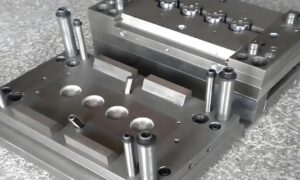
A manufacturing die is a precision tool used to cut, shape, or form metal parts. According to the manufacturing process, dies are mainly divided into stamping dies and casting molds.
Stamping dies are mainly used for sheet metal forming. They use a press machine to apply pressure and create the required shape without melting the material.
Common stamping dies include:
- Compound die
- Progressive die
- Flanging die
- Blanking die
- Bending die
Casting molds work differently. They shape molten metal by filling a mold cavity and allowing the material to cool and solidify.
What Is a Compound Die?
A compound die is a stamping die that completes two or more operations in one press stroke.
Unlike progressive dies that perform different operations at different stations, a compound die completes multiple processes at the same position. This means the finished part can be produced directly after one stamping operation.
Typical operations include blanking and piercing.
Advantages of Compound Die
The biggest advantage of a compound die is high accuracy.
Because all operations are completed at the same time, the position relationship between different features is very precise. It is suitable for parts that require good dimensional accuracy and consistent quality.
Limitations of Compound Die
The structure of a compound die is more complex, so manufacturing and maintenance costs are usually higher.
It is not always the best choice for extremely large production volumes where production speed is the top priority.
Applications
Compound dies are commonly used for precision parts such as washers, electronic components, and small metal parts.
What Is a Progressive Die?
A progressive die is a multi-station stamping tool designed for continuous production.
During the stamping process, the metal strip moves forward step by step. Each station completes one operation until the final product is finished.
For example, one station may perform punching, another station may perform bending, and the final station separates the finished part.
Advantages of Progressive Die
The biggest advantage of a progressive die is high production efficiency.
It can work continuously with automatic feeding systems, making it ideal for large-volume manufacturing. It reduces labor costs and provides stable product quality.
Limitations of Progressive Die
Progressive dies require more complicated design and higher initial investment.
Tool manufacturing takes longer, and maintenance requires experienced technicians.
Applications
Progressive dies are widely used for high-volume products such as electronic terminals, automotive parts, and metal connectors.
What Is a Flanging Die?
A flanging die is a special stamping die used to create flanges on sheet metal parts.
Unlike compound dies and progressive dies, a flanging die mainly focuses on one forming process. It bends the edge of metal or creates a flange around a hole to improve strength and assembly performance.
Advantages of Flanging Die
Flanging dies have a simpler structure compared with compound dies and progressive dies.
They are easier to manufacture, easier to maintain, and provide stable forming results.
Applications
Flanging dies are commonly used for sheet metal products such as automotive panels, electrical cabinets, and metal housings.
What Is a Casting Mold?
A casting mold is used in the metal casting process. Unlike stamping dies that form solid metal sheets, casting molds shape liquid metal.
The process is simple:
First, metal is melted.
Then, the molten metal is poured or injected into the mold cavity.
After cooling, the finished casting part is removed.
Advantages of Casting Mold
Casting molds can produce complex shapes that are difficult to manufacture with stamping processes.
They are suitable for parts with thick sections, internal cavities, or complicated structures.
Limitations of Casting Mold
Casting requires strict process control because problems such as porosity, shrinkage, and surface defects may occur.
Some cast parts also require additional machining after production.
Applications
Casting molds are commonly used for products such as engine housings, pump bodies, and industrial machine parts.
Compound Die vs Progressive Die vs Flanging Die vs Casting Mold
| Tool Type | Main Feature | Best Choice For |
|---|---|---|
| Compound Die | Multiple operations in one stroke | High-precision parts |
| Progressive Die | Continuous multi-station production | Large-volume manufacturing |
| Flanging Die | Creates metal flanges | Edge forming applications |
| Casting Mold | Forms molten metal | Complex metal components |
How to Choose the Right Die?
The best choice depends on your product requirements.
Choose a compound die if you need high accuracy and consistent dimensions.
Choose a progressive die if you need fast production and large quantities.
Choose a flanging die if your main requirement is flange forming.
Choose a casting mold if your product has complex shapes or internal structures.
Important factors include production quantity, material type, product design, tolerance requirements, and tooling cost.
Conclusion
The difference between compound die vs progressive die vs flanging die vs casting mold mainly comes from their manufacturing methods and production goals.
Compound dies focus on precision, progressive dies focus on high-speed production, flanging dies focus on flange forming, and casting molds focus on complex metal shapes.
Selecting the correct tooling solution can help manufacturers improve efficiency, reduce production costs, and achieve better product quality.

