
Press brake tooling is an essential part of sheet metal fabrication. The right tooling affects bending accuracy, product quality, production efficiency, and tool life. Since different workpieces require different bending shapes and processes, press brake tools are available in a wide range of designs.
This guide explains the main types of press brake tooling, their features, common materials, design considerations, and basic maintenance tips. It will help you better understand how to choose the right tooling for different sheet metal bending applications.
Common Types of Press Brake Tooling
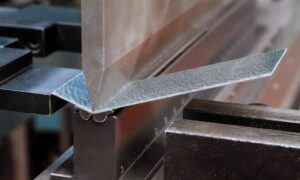
V-Die Tooling
V-dies are among the most commonly used press brake tools. The lower die has a V-shaped opening that supports the sheet during bending, while the upper punch presses the material into the die.
V-dies can be used for a wide range of sheet metal applications and are suitable for different material thicknesses and bending angles. They are relatively simple to use, cost-effective, and available in many opening sizes.
The V-opening is usually selected according to the material thickness, bending method, and required bending radius. Choosing the correct V-opening can help achieve consistent bending results and reduce surface damage.
U-Die Tooling
U-dies are designed for applications that require deeper or special-shaped bends. Their structure allows the workpiece to enter a deeper die area, making them useful for certain structural components and complex sheet metal parts.
Compared with standard V-dies, U-dies are used for more specific bending requirements. They can be particularly useful when a workpiece needs a deeper forming shape or a special cross-section.
Straight-Edge Tooling
Straight-edge tooling is mainly used when producing straight or simple bending profiles. It has a relatively simple structure and is suitable for applications where the bending geometry is not complicated.
This type of tooling can be found in industries such as furniture manufacturing, construction, electrical equipment, and general sheet metal fabrication. Its simple design also makes it convenient for routine production work.
Special Press Brake Tooling
In addition to standard V-dies and U-dies, manufacturers can choose special tooling for specific bending requirements. Common options include radius tooling, offset tooling, gooseneck punches, acute-angle tooling, and other customized tools.
Radius tooling is designed for large-radius bends, while offset and gooseneck tooling can provide additional clearance for complex workpieces. Special tooling is especially useful when standard punches and dies cannot achieve the required shape or when interference between the tooling and workpiece needs to be avoided.
Press Brake Tooling Materials
Tool material has a direct impact on bending performance, wear resistance, service life, and overall production cost. Different applications require different material properties.
Alloy Steel
Alloy steel is widely used for press brake tooling because it provides a good balance of strength, toughness, and wear resistance. Properly treated alloy steel tooling can withstand repeated bending pressure and impact during demanding production.
It is suitable for general sheet metal fabrication as well as many medium- and heavy-duty bending applications.
High-Speed Steel
High-speed steel offers high hardness and excellent wear resistance. It can be considered for applications where tooling is exposed to high levels of wear or where longer service life is required.
High-speed steel tooling is generally more expensive than standard tooling materials, so it is normally selected when its performance advantages justify the additional cost.
Hardened Steel
Hardened steel tooling undergoes heat treatment to improve hardness, wear resistance, and durability. It is commonly used in high-volume production where the tooling needs to maintain its performance over a large number of bending cycles.
For manufacturers handling large production orders, hardened tooling can help reduce tool replacement frequency and maintain more consistent bending quality.
Other Tool Materials
For specialized applications, other materials or surface treatments may also be used. The correct choice depends on the material being bent, production volume, required accuracy, bending force, and expected tooling life.
In most industrial applications, metal tooling remains the preferred option because of its strength and durability.
Key Press Brake Tooling Design Considerations
Tooling design has a direct influence on bending accuracy and production efficiency. Several factors should be considered before selecting or designing press brake tooling.
Bending Angle
Different workpieces require different bending angles. Tooling should therefore be selected according to the required angle and bending method.
For example, standard V-dies can handle many common bending applications, while acute-angle or special tooling may be needed for more specific angles.
Tool Dimensions
Tool dimensions must match the press brake and the workpiece. The tooling must have sufficient load capacity and an appropriate working length.
The die opening should also be suitable for the material thickness. An unsuitable die opening can affect the bending radius, bending force, surface quality, and final angle.
Material Thickness
Sheet thickness is another important factor when selecting tooling. Thin sheets and thick plates require different tooling configurations and bending parameters.
Using the correct punch and die combination helps distribute the bending force properly and reduces the risk of excessive deformation or tooling damage.
Stress Distribution
Tooling should be designed to handle the forces generated during bending. Poor load distribution can create excessive stress concentrations, which may lead to premature tool wear, cracking, or workpiece deformation.
For demanding applications, tooling strength, heat treatment, geometry, and load capacity should all be evaluated before production.
How to Maintain Press Brake Tooling
Proper maintenance can significantly extend tooling life and help maintain consistent bending quality.
Check Tool Wear Regularly
Inspect punches and dies regularly for wear, scratches, deformation, cracks, or other damage. Severely worn tooling should be repaired or replaced as soon as possible.
Using damaged tooling can reduce bending accuracy and may also damage the workpiece or press brake.
Keep Tooling Clean
Metal chips, dust, oil, and other contaminants should be removed after use. Clean tooling helps prevent surface damage and reduces the risk of corrosion.
Before storage, make sure the tooling is clean and dry.
Store Tooling Properly
When tooling is not being used, store it in a dry and well-ventilated environment. Avoid prolonged exposure to moisture, high temperatures, and corrosive substances.
Organizing punches and dies properly also makes tool selection faster and reduces the risk of accidental damage.
How to Choose the Right Press Brake Tooling
Choosing the right tooling is not simply a matter of selecting a punch and die that fit the machine. The material, thickness, bending angle, bending radius, workpiece shape, production volume, and required accuracy should all be considered.
For general-purpose sheet metal bending, standard V-dies and commonly used punches are often a practical choice. For complex profiles, deep bends, large-radius bends, or parts with limited clearance, specialized tooling may provide better results.
Manufacturers should also consider tooling quality and heat treatment. High-quality tooling can provide better dimensional stability, longer service life, and more consistent bending performance.
The Future of Press Brake Tooling
Press brake tooling is also developing alongside modern manufacturing technology. Automation, CNC control, and intelligent production systems are making bending operations more precise and efficient.
In the future, smart tooling systems may provide better compatibility with automated press brakes and production management systems. Tool identification, automatic tool setup, and digital production data can help reduce setup time and improve manufacturing efficiency.
At the same time, tooling manufacturers are continuing to explore improved materials, heat treatments, coatings, and manufacturing processes to increase wear resistance and extend tool life.
Customized and multifunctional tooling is also becoming increasingly important as manufacturers handle more product variations and smaller production batches.
Press brake tooling plays a critical role in modern sheet metal fabrication. V-dies, U-dies, straight-edge tooling, radius tooling, offset tooling, and other special tools each have their own applications and advantages.
The right tooling should be selected according to the material, thickness, bending angle, workpiece design, production requirements, and press brake specifications. At the same time, regular inspection, cleaning, and proper storage can help extend tooling life and maintain stable bending quality.
With the development of CNC bending, automation, and advanced tooling technology, press brake tooling will continue to become more precise, durable, and flexible, helping manufacturers improve both productivity and finished-product quality.

