
Press brake tooling is an essential auxiliary tool used with press brakes for sheet metal forming and bending operations. It consists of multiple components, and different tooling designs are developed according to different processing requirements and workpiece shapes.
The main purpose of press brake tooling is to change the physical shape of metal sheets through the pressure generated by the press brake. By controlling the movement of the upper and lower tools, the sheet metal can be formed into the required shapes with high accuracy and repeatability.
With the development of CNC press brake technology, CNC press brake tooling has become more precise, efficient, and flexible, helping manufacturers improve production quality and reduce processing costs.
1. Structure and Classification of CNC Press Brake Tooling
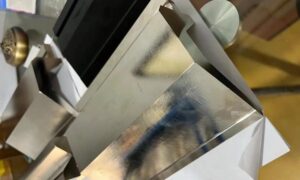
From a structural perspective, press brake tooling is mainly divided into two parts: the upper tool and the lower tool.
The upper tool is usually the active part, also known as the moving tool, because it moves together with the press brake ram during bending operations. The lower tool is normally the fixed part, also called the stationary tool, which supports the sheet material during forming.
However, depending on different press brake working structures, the movement relationship between the upper and lower tools may vary. The basic function remains the same: applying controlled pressure to achieve accurate sheet metal bending.
In practical applications, CNC press brake tooling can generally be divided into standard tooling and special tooling. Standard tooling is commonly used for regular bending operations, while special tooling is designed for specific workpiece shapes or complex forming requirements.
For example, common standard tooling includes:
30° punch tooling, 60° punch tooling, special angle punch tooling, and various V-opening die options.
The actual punch angle is usually designed according to bending requirements. For example, a 30° punch may have an actual working angle of approximately 26°–28° depending on the tooling design.
2. Types of CNC Press Brake Upper Tooling
According to shape design, CNC press brake upper tools can mainly be divided into pointed punches, radius punches, gooseneck punches, and forming punches.
Pointed Punch
Pointed punches are the most commonly used press brake tools. They are usually available in 30° and 60° designs, while special angles such as 45° and 55° can also be produced according to customer requirements.
They are widely used for general sheet metal bending applications because they provide accurate positioning and good bending performance.
Radius Punch
Radius punches are designed with different arc diameters and lengths. They are mainly used when the workpiece requires a larger bending radius or smooth curved forming.
Compared with standard pointed punches, radius tooling can reduce surface damage and improve the appearance quality of finished products.
Gooseneck Punch
Gooseneck tooling is mainly used for U-shaped parts or workpieces that require additional clearance during multiple bending operations.
Its special curved structure allows the tool to avoid interference with previously formed sections, making it suitable for complex bending processes.
Forming Punch
Forming tooling is the most complex type of press brake tooling. It can be manufactured as an integrated structure or assembled from multiple components.
Integrated forming tools usually have higher manufacturing costs, especially for large-size tooling, and precision control can be more difficult.
Compared with integrated tooling, combined forming tools have greater advantages when producing large parts or complex shapes because they provide better flexibility and easier adjustment.
3. CNC Press Brake Tooling Classification by Function
According to functional requirements, press brake tooling can be divided into single-purpose tooling and multifunctional tooling.
Single-purpose tooling is designed to produce one specific type of workpiece or perform one bending operation.
Multifunctional tooling, on the other hand, can process different types of parts. Some designs allow the tooling to be separated and assembled according to production requirements.
These are often called compound tooling.
Examples include:
Step bending tooling, forming tooling, and customized combination tooling.
Multifunctional tooling is especially useful for manufacturers producing various sheet metal products because it reduces tooling replacement frequency and improves production flexibility.
4. Types of CNC Press Brake Lower Dies
According to the number of V-grooves, CNC press brake lower dies can mainly be divided into single-V dies, double-V dies, and multi-V dies.
Single-V Die
A single-V die has only one V-opening on the working surface. It is widely used in CNC press brake applications because it provides a fixed bending reference and high machining accuracy.
Double-V Die
A double-V die contains two different V-openings, allowing operators to select different bending conditions without replacing the entire die.
Both single-V and double-V dies are often designed as concentric tooling, meaning they can maintain accurate positioning and easy replacement.
Multi-V Die
Multi-V dies usually have a square structure with multiple V-grooves on different sides. Each groove has different dimensions to meet different sheet thickness requirements.
The main advantage of multi-V tooling is flexibility. A single die can support various bending operations, reducing the need for multiple lower dies.
5. New Developments in CNC Press Brake Tooling Technology
With increasing requirements for product quality and surface protection, CNC press brake tooling continues to improve through new materials and technologies.
Modern press brake tooling includes:
- Insert-type lower dies
- No-marking lower dies
- Adjustable opening lower dies
These advanced tooling solutions are widely used in different industries to improve bending quality and production efficiency.
Insert-Type Lower Dies
Insert-type tooling is mainly developed to improve material utilization and provide better solutions for special bending applications.
By replacing only the working insert instead of the entire die, manufacturers can reduce tooling costs and increase flexibility.
No-Marking Lower Dies
No-marking lower dies are designed to prevent scratches, surface damage, and pressure marks on finished products.
Common designs include:
Ball-type no-marking dies, flip-type no-marking dies, and polyurethane no-marking dies.
They are especially suitable for stainless steel, aluminum, and other materials requiring high surface quality.
Adjustable Opening Lower Dies
Adjustable opening dies are designed to improve tooling adaptability.
Different structures include:
Insert-type designs, wedge-type designs, and rack-type adjustable systems.
The main advantages of adjustable opening tooling are:
Higher material utilization, shorter tooling replacement time, and improved production efficiency.
Conclusion
CNC press brake tooling plays an important role in modern sheet metal fabrication. Its structure, design, and technology directly affect bending accuracy, production efficiency, and final product quality.
From standard punches and V-dies to advanced no-marking tooling and adjustable opening systems, press brake tooling continues to evolve with the development of manufacturing technology.
Through continuous improvements in materials, design methods, and production processes, modern CNC press brake tooling helps manufacturers produce higher-quality products faster and more efficiently, providing stronger support for the future development of the metal fabrication industry.

