
Press brake tooling is an essential tool in sheet metal fabrication. It comes in various types, including L-type, R-type, U-type, Z-type, and other bending profiles, to meet different forming requirements. The upper tooling is available in multiple angles, such as 90°, 88°, 45°, 30°, 20°, and 15°, providing flexible solutions for different bending applications.
The lower tooling includes various V openings ranging from 4V to 18V, available in both double-V and single-V designs. Special types such as R dies, acute angle dies, and flattening dies are also available to meet different material and process requirements.
In terms of structure, press brake tooling can be divided into segmented tooling and one-piece tooling. Standard segmented upper punches are usually available in lengths of 300mm, 200mm, and 100mm, while full-length upper punches are typically 835mm. Lower dies are also available in different sizes, including 400mm, 200mm, and 100mm segments, as well as 835mm full-length versions. These diverse specifications allow press brake tooling to handle a wide range of bending applications.
Press brake tooling is manufactured from specially heat-treated tool steel, providing high hardness, excellent wear resistance, and strong load-bearing capacity. However, every tooling set has a maximum pressure capacity, usually marked in “tons per meter.” During operation, users must select the correct bending pressure according to the tooling length to ensure that the maximum rated pressure is not exceeded.
Safe Operation Guidelines for Press Brake Tooling
1. Correct Tooling Alignment and Machine Origin Setting
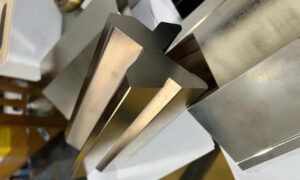
When setting the machine origin point, always use upper and lower tooling with a length of more than 300mm to prevent tooling damage. After the origin is properly calibrated, operators can replace the tooling with upper and lower tools of the same height for production.
Never use small segmented tooling for origin setting. The origin adjustment process must follow the specified origin pressure settings inside the AMADA machine system.
2. Use Tooling with the Same Height
Different press brake tooling may have different heights. When multiple tooling sets are used on the same machine, make sure that all selected tools have the same height. Using tooling with different heights may affect bending accuracy and create safety risks.
3. Choose the Right Tooling According to Material Conditions
The selection of upper and lower tooling should be based on the material type, hardness, thickness, and length of the sheet metal.
Normally, the lower die opening is selected according to the 5–6T rule. The die length should be slightly longer than the workpiece length. For thicker and harder materials, a wider V-opening should be selected to achieve better bending performance and avoid excessive stress on the tooling.
4. Tool Selection for Special Bending Applications
For sharp angle bending or closed-angle bending, a 30° upper punch is recommended. First complete the acute angle bending process, then perform flattening or hemming operations.
For R-angle bending applications, operators should select matching R-type upper punches and lower dies according to the required radius.
5. Avoid Using Segmented Tooling for Long Workpieces
When bending long workpieces, avoid using segmented tooling whenever possible because it may leave visible joint marks on the finished product.
A single-slot lower die is recommended because its larger external V-groove radius can reduce bending marks and improve surface quality.
6. Understand Tooling Specifications Before Use
Before selecting upper tooling, operators should fully understand all tooling specifications, including bending angle, height, radius, pressure capacity, and application range.
Choose the most suitable tooling according to the shape and forming requirements of the final product.
7. Avoid Overloading the Tooling
When bending extremely hard materials or thick plates, never use press brake tooling to bend steel bars, round rods, or other cylindrical materials.
Improper applications may exceed the tooling capacity and cause tooling failure or accidents.
8. Pay Attention to Safety During Operation
Operators must remain focused during the entire bending process.
After the machine origin is set, always lock the upper and lower tooling properly to prevent tooling from falling and causing damage or injury.
During pressing operations, increase pressure gradually instead of applying maximum force suddenly. Always monitor the machine display and pressure data changes.
9. Proper Tooling Storage and Maintenance
After finishing production, return the tooling to the designated tooling rack and store it according to the marked position.
Regularly clean dust, metal chips, and contaminants from the tooling surface. Apply anti-rust oil when necessary to prevent corrosion and maintain tooling accuracy and service life.
IVILA Press Brake Tooling Solutions
IVILA has been specializing in press brake tooling manufacturing for many years, providing high-quality tooling solutions for customers worldwide.
Our product range includes CNC press brake standard tooling, conventional press brake tooling, offset bending tooling, combination tooling, special tooling, and customized non-standard forming tools.
We also provide solutions such as mark-free bending tooling, three-point bending tooling, and customized tooling designs according to customers’ specific requirements.
With advanced manufacturing technology, strict quality control, and professional engineering support, IVILA is committed to providing reliable press brake tooling that improves bending accuracy, production efficiency, and machining quality.
IVILA provides professional press brake tooling solutions for global sheet metal fabrication industries.