
Wrinkling is one of the most common defects in the deep drawing process of stamping parts. During stamping die forming, sheet metal must flow smoothly under the control of the punch, die, and blank holder. When the material flow is unstable or excessive material accumulates in certain areas, wrinkles may appear on the surface or edge of the formed part.
Wrinkling not only affects the appearance of stamping parts but also reduces dimensional accuracy and may lead to product rejection. Therefore, controlling material flow and optimizing stamping die design are important methods to improve forming quality.
1. Main Factors Affecting Wrinkling in Stamping Parts
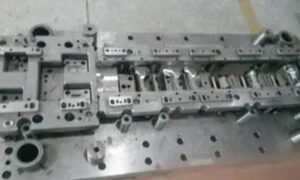
The occurrence of wrinkles during stamping die forming is mainly related to drawing depth, blank holder force, die radius, and material flow conditions.
The drawing depth has a direct influence on the distribution of material deformation resistance. When the drawing depth is too large, especially in areas with complex curved shapes, the material may experience uneven deformation resistance. This causes unstable material flow and increases the possibility of wrinkling. For deep drawing parts, the forming process should be reasonably designed to avoid excessive drawing depth in one operation.
Blank holder force is another important factor affecting wrinkling. If the pressure is too low, the sheet metal cannot be effectively controlled during the drawing process, causing excessive material movement and wrinkles around the edge of the part. Increasing the blank holder force can improve material control and reduce wrinkles. However, excessive pressure should also be avoided because it may restrict material flow and cause cracking.
For conical parts and hemispherical parts, most of the material is suspended at the beginning of forming, making sidewall wrinkles easier to occur. In these cases, increasing blank holder force or adding draw beads can improve radial tensile stress and help stabilize the forming process.
The die corner radius also has a significant influence on wrinkling. If the die radius is too large, the resistance during material bending becomes smaller, allowing the sheet metal to flow too quickly into the die cavity. Excess material may accumulate and create wrinkles. On the other hand, if the die radius is too small, material flow resistance increases, which can reduce wrinkling but may cause cracking, scratching, or excessive thinning.
In actual stamping die production, most wrinkling problems are caused by excessive material accumulation and uncontrolled material flow speed. Adjusting the die structure and forming parameters according to the specific part condition is usually the most effective solution.
2. Effective Methods to Prevent Wrinkling in Stamping Die Forming
The key to preventing wrinkles is maintaining a balanced material flow during the deep drawing process. The stamping die must provide enough pressure to control the sheet metal while allowing the material to move smoothly into the forming area.
A proper blank holder system is one of the most effective solutions. During drawing, the blank holder presses the flange area of the sheet metal to prevent the material from lifting and folding. According to different forming requirements, elastic blank holders and rigid blank holders can be selected. Elastic systems are generally suitable for shallow drawing parts, while rigid systems are more suitable for deeper drawing applications that require stronger material control.
Draw beads are also widely used in stamping dies to improve material flow control. By creating additional resistance in specific areas, draw beads can slow down excessive material movement and make the deformation process more uniform. They are especially useful for complex curved parts or components with small flanges.
The position and size of draw beads must be carefully designed. If the resistance is too small, wrinkles cannot be effectively controlled. If the resistance is too large, the material may not flow sufficiently and cracking may occur. In some cases, additional process material can be added to allow better draw bead design, and the extra material can be removed during trimming.
For deep drawing parts with uneven forming depths, draw beads should usually be placed in areas where material enters the die cavity too easily. This helps prevent excessive material accumulation and improves overall forming stability.
3. Common Causes of Wrinkling in Deep Drawing Parts
Wrinkling in deep drawing parts is usually caused by improper stamping die design, incorrect process parameters, or unstable material flow conditions.
One common cause is excessive drawing depth. When the part is too deep for a single drawing operation, the sheet metal may move too quickly in some areas, resulting in uneven thickness distribution and surface wrinkles.
Another reason is an improper die corner radius. When the die R angle is too large, the punch cannot effectively control the sheet metal during forming, allowing excessive material movement and increasing the risk of wrinkles.
Incorrect draw bead design is also a frequent problem. If the draw bead height is too small or the position is not suitable, it cannot provide enough resistance to control material flow. As a result, too much material enters the die cavity and creates wrinkles.
Insufficient cushion pressure or ejector force may also cause incomplete forming. When the material is not held properly during the stamping process, the part may deform unevenly and develop wrinkles.
In addition, unreasonable positioning design and excessive clearance between the punch and die can reduce material control during forming. When the sheet metal cannot be properly restrained, excessive movement occurs and wrinkles are more likely to appear.
Conclusion
Wrinkling is a common quality problem in stamping die deep drawing processes. The main causes include excessive material flow, insufficient blank holder force, improper die radius, incorrect draw bead design, and unsuitable die clearance.
To reduce wrinkling defects, manufacturers should focus on optimizing stamping die structure, controlling material movement, adjusting forming parameters, and selecting suitable blank holding methods.
A well-designed stamping die can effectively control sheet metal deformation, improve product quality, reduce production waste, and achieve stable high-volume manufacturing.

