
Introduction to Stamping Die Terminology
In the metal stamping industry, stamping die is one of the most important tools used for producing high-precision sheet metal components. A stamping die works together with a punch press to cut, bend, form, and shape metal sheets into finished products.
From simple flat parts to complex three-dimensional components, different stamping die structures are designed according to production requirements, material characteristics, product shape, and accuracy standards.
For engineers, die designers, and manufacturing technicians, understanding common stamping die terminology is essential. Familiarity with different stamping processes helps improve die design, reduce production problems, extend tool life, and achieve stable mass production.
The main stamping die processes can be divided into four major categories:
1. Stamping Die Cutting and Separation Processes
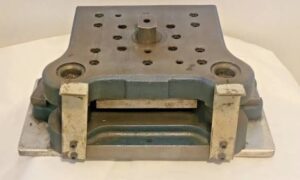
Cutting and separation processes are the basic operations in stamping die manufacturing. These processes use the cutting edges of punches and dies to separate sheet metal into required shapes or remove unwanted material from workpieces.
Among all stamping operations, punching and blanking are the most widely used methods. They are commonly applied in high-volume production because they provide fast processing speed, consistent dimensions, and reliable production efficiency.
Punching is a stamping die process that removes material from a sheet metal part to create holes or openings. During operation, the punch moves downward and cuts the material against the die edge. The removed material becomes scrap, while the remaining sheet becomes the finished component.
Punching is widely used for manufacturing automotive brackets, electronic connectors, electrical enclosures, hardware components, and precision metal parts.
Blanking is another important stamping die cutting process. Unlike punching, the separated material becomes the final product instead of waste. The blanking process is commonly used for producing flat components that require accurate dimensions and smooth edges.
Typical blanking applications include metal washers, precision plates, mechanical parts, electrical components, and small hardware products.
Besides punching and blanking, other separation processes such as trimming, notching, slitting, and cutting off are also widely used in stamping die production.
Trimming is usually performed after forming or deep drawing operations to remove excess material and improve the final shape accuracy. Notching removes material from the edge of a sheet metal part to create specific openings or shapes. Cutting off separates finished parts from strips or connected material.
These cutting processes are essential for achieving accurate product dimensions and improving overall stamping quality.
2. Stamping Die Forming Processes
Forming processes are another important category of stamping die operations. Unlike cutting processes, forming changes the shape of sheet metal through plastic deformation without completely separating the material.
During forming, the material flows under pressure and follows the shape of the punch and die cavity. This allows manufacturers to produce complex structures while maintaining good material strength.
A progressive die is one of the most commonly used stamping die solutions for large-scale production. It contains multiple working stations inside one die set. As the metal strip moves through each station, different operations are completed continuously.
A single progressive die can combine several processes, including punching, bending, embossing, forming, and trimming. This greatly improves production efficiency and reduces manual handling.
Progressive stamping dies are widely used in industries that require high-volume manufacturing, such as automotive production, electronics manufacturing, communication equipment, and precision hardware.
Embossing is another common stamping die forming process. It creates raised or recessed patterns on the surface of sheet metal by pressing the material into a designed cavity.
Embossing can improve product appearance, increase structural strength, reduce deformation, and create identification marks. It is commonly used for automotive panels, electronic covers, appliance housings, decorative metal sheets, and nameplates.
Forming is a general term that covers many processes where sheet metal changes shape through controlled material flow. These processes are widely used for producing complex components that cannot be manufactured through simple cutting methods.
Common forming applications include metal brackets, machine covers, structural components, and industrial sheet metal parts.
3. Stamping Die Bending and Deep Drawing Processes
Bending and deep drawing are important stamping die processes used to manufacture three-dimensional metal components.
Bending is one of the most common sheet metal forming methods. It uses a punch and die to apply pressure and permanently deform the material into a specific angle or radius.
During the bending process, the sheet metal does not lose material. Instead, the internal structure changes through plastic deformation, creating the required shape.
Bending stamping dies are widely used for producing electrical cabinets, support brackets, machine frames, metal covers, and structural components.
The quality of a bending process depends on several factors, including material properties, bending angle, die clearance, punch radius, and tooling accuracy.
Deep drawing is a more complex stamping die process that transforms a flat sheet metal blank into a hollow component.
During deep drawing, the punch pushes the material into the die cavity while the surrounding material flows inward. Proper control of material flow is important because excessive stretching may cause cracking, while insufficient control may result in wrinkles.
Deep drawing is commonly used for manufacturing automotive parts, metal containers, appliance housings, kitchen equipment components, and industrial products.
For complex deep drawing applications, multiple drawing operations may be required. Progressive deep drawing uses several forming stages to gradually achieve the final shape and size.
This method improves forming stability and is suitable for high-volume production of deep-drawn components.
Hydraulic deep drawing is another advanced forming method. Instead of relying only on a traditional rigid punch or die, hydraulic pressure is used to control material flow and form complex shapes.
4. Special Stamping Die Processes
Besides common cutting, forming, bending, and drawing operations, some special stamping die processes are used to meet specific product requirements.
Flanging is a stamping process that forms a raised edge or flange around a hole or outer contour of a sheet metal part.
The flange can improve component strength, provide better assembly performance, and prepare the part for welding or connection.
Flanging is commonly used in automotive components, metal pipes, electrical housings, and structural sheet metal products.
Curling is another special stamping die process. It rolls the edge of a metal part into a rounded or nearly closed shape.
Curling improves edge safety, prevents sharp edges, and increases product appearance. It is commonly found in metal containers, tubes, household hardware, and packaging components.
Rib forming creates raised reinforcement structures on sheet metal parts. These ribs improve stiffness and reduce deformation without significantly increasing material thickness.
Rib forming is widely used for automotive panels, machine covers, electrical cabinets, and other structural sheet metal components.
Other special processes, such as bulging, leveling, sizing, and hole flanging, also play an important role in modern stamping die manufacturing.
Bulging expands hollow components outward to create special shapes. Leveling improves the flatness of stamped parts. Sizing adjusts dimensions and improves accuracy after forming.
These processes allow manufacturers to produce more complex and higher-quality metal products.
Conclusion
Stamping die technology covers a wide range of manufacturing processes, from simple cutting operations to advanced forming and deep drawing methods.
Cutting processes such as punching, blanking, and trimming are mainly used for material separation. Forming processes create complex shapes through controlled deformation. Bending and deep drawing produce three-dimensional components, while special stamping processes improve product performance and appearance.
Understanding stamping die terminology is important for improving tooling design, optimizing production processes, and reducing manufacturing costs.
With proper stamping die selection, accurate design, and professional maintenance, manufacturers can achieve higher production efficiency, better product quality, and longer tool service life in modern metal stamping operations.

