
A pneumatic punch press is an efficient metal stamping machine powered by compressed air. It is widely used for punching, blanking, forming, cutting, and other sheet metal processing operations. Compared with traditional mechanical punch presses, a pneumatic punch press offers cleaner operation, lower energy consumption, faster response, and easier maintenance, making it an excellent choice for light- and medium-duty manufacturing.
Today, pneumatic punch presses are commonly found in industries such as sheet metal fabrication, electronics, electrical components, automotive parts, and hardware manufacturing. Whether producing small precision components or high-volume stamped parts, these machines provide stable performance and reliable production efficiency.
What Is a Pneumatic Punch Press?
A pneumatic punch press is a stamping machine that uses compressed air instead of a flywheel or hydraulic system to generate punching force. Air pressure drives a pneumatic cylinder, which moves the ram up and down to complete various stamping operations.
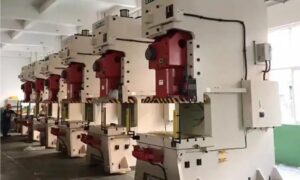
Because the power source is compressed air, the machine has a relatively simple structure and fewer moving parts than conventional mechanical presses. This reduces maintenance requirements while providing quick and accurate movement during production.
A pneumatic punch press is suitable for processing materials such as carbon steel、stainless steel、aluminum、copper、brass、plastic sheets and many other thin materials.
How Does a Pneumatic Punch Press Work?
The working principle of a pneumatic punch press is straightforward. Compressed air generated by an air compressor is delivered to the machine through air pipelines. A control valve regulates the airflow, causing the pneumatic cylinder to move the ram downward.
Once the ram reaches the bottom of its stroke, the punch and die complete the stamping operation. Afterward, the compressed air is redirected, allowing the cylinder to return the ram to its starting position and prepare for the next cycle.
Most pneumatic punch presses operate with an air pressure between 0.5 MPa and 0.8 MPa, providing stable force for punching, blanking, bending, embossing, and other light-duty forming operations.
Because of this simple operating principle, pneumatic punch presses achieve fast cycle times while maintaining consistent production quality.
Why Choose a Pneumatic Punch Press?
Many manufacturers prefer pneumatic punch presses because they combine high efficiency with relatively low operating costs.
Unlike hydraulic machines that continuously consume energy to maintain system pressure, a pneumatic punch press only uses compressed air during the working cycle, reducing overall energy consumption.
Another major advantage is its clean operation. Since hydraulic oil is not required, there is no risk of oil leakage, making the machine more environmentally friendly and easier to maintain.
The compact mechanical structure also simplifies installation and servicing. With fewer transmission components, routine maintenance becomes faster and machine downtime is reduced.
In addition, pneumatic systems generally produce lower operating noise than conventional mechanical punch presses, creating a more comfortable working environment.
Fast cylinder response also enables high production speeds, with many models capable of reaching 200 to 500 strokes per minute, depending on machine size, tooling, and workpiece design.
Pneumatic Punch Press Applications
A pneumatic punch press is suitable for a wide variety of stamping operations across different industries.
Typical applications include hole punching、blanking、forming、bending、embossing、trimming, as well as the production of precision sheet metal parts.
Manufacturers commonly use pneumatic punch presses to produce electronic connectors、electrical terminals、appliance components、metal brackets、hardware accessories、automotive parts and many other products requiring accurate stamping.
These machines perform particularly well when processing sheet materials between 1 mm and 3 mm thick, where high production speed and consistent quality are essential.
Main Components of a Pneumatic Punch Press
Although different manufacturers may offer various configurations, the basic structure of a pneumatic punch press remains similar.
The air cylinder serves as the primary power source, converting compressed air into linear movement. A solenoid valve controls airflow, allowing the ram to move precisely during each production cycle.
The ram carries the upper die and works together with the punch and die set to perform stamping operations.
The control system manages machine functions such as starting, stopping, emergency protection, and production cycles, while the air supply system—including the air compressor, air filter, pressure regulator, and pipelines—ensures stable air pressure throughout production.
Each component plays an important role in maintaining accuracy, reliability, and production efficiency.
How to Install a Pneumatic Punch Press
Proper installation is the foundation for stable machine performance.
Before installation, the machine should be placed on a strong, level floor capable of supporting its operating load. Machine leveling should be carefully checked to prevent vibration and maintain stamping accuracy.
The compressed air supply must then be connected using appropriately sized air hoses. Air pressure should be adjusted according to the manufacturer’s specifications before production begins.
After the air system is ready, the upper and lower dies are installed and aligned. Correct die clearance should be selected according to the material type and thickness to achieve the best cutting quality while minimizing tool wear.
Proper installation not only improves production accuracy but also extends the service life of both the machine and the tooling.
How to Operate a Pneumatic Punch Press Safely
Safe operation begins with a thorough inspection before starting production.
Operators should confirm that the emergency stop system functions correctly, air pressure remains stable, tooling is securely installed, and all protective guards are properly positioned.
Before processing actual workpieces, several trial strokes should be performed without material. This allows operators to verify smooth ram movement, stable air pressure, and the absence of abnormal vibration or unusual noise.
Once normal operation has been confirmed, production can begin.
During continuous operation, machine performance and product quality should be monitored regularly. Guide rails should be lubricated periodically using suitable lubricating oil to reduce friction and maintain smooth movement.
Pneumatic Punch Press Maintenance Tips
Regular maintenance is essential for maximizing the performance and service life of a pneumatic punch press.
Routine inspections should focus on the pneumatic system, cylinder seals, guide rails, fasteners, electrical controls, and tooling condition. Any signs of air leakage or abnormal wear should be addressed immediately.
Proper lubrication helps reduce friction between moving components and prevents premature wear of the guide system.
Keeping the machine clean is equally important. Dust, metal chips, and other debris should be removed regularly to prevent contamination of precision components.
A well-maintained pneumatic punch press delivers higher production efficiency, better stamping quality, and lower long-term operating costs.
Common Pneumatic Punch Press Problems
Like any industrial equipment, a pneumatic punch press may occasionally experience operational issues.
Air leakage is often caused by loose fittings, damaged seals, or worn air hoses. Regular inspection of pneumatic connections can quickly eliminate these problems.
If the ram does not move smoothly, possible causes include insufficient air pressure, inadequate lubrication, or contamination on the guide rails.
Poor stamping quality is usually related to incorrect die clearance, worn punches, unstable air pressure, or damaged tooling. Timely inspection and adjustment help restore consistent production accuracy.
Preventive maintenance is always more economical than repairing unexpected machine failures.
Improving Pneumatic Punch Press Precision
For manufacturers producing high-precision components, pneumatic punch presses can be upgraded with servo control systems.
Servo technology improves ram positioning accuracy, enhances repeatability, and provides more consistent forming performance during continuous production.
The upgrade also reduces material waste, improves finished product quality, and increases overall production efficiency.
Although adding servo control increases the initial investment, many manufacturers recover the additional cost through higher productivity, lower scrap rates, and reduced maintenance expenses.
Conclusion
A pneumatic punch press is a practical, reliable, and cost-effective solution for modern metal stamping operations. Its compressed-air-driven system offers fast response, clean operation, low maintenance requirements, and excellent production efficiency.
Whether manufacturing electronic components、automotive parts、hardware products、electrical accessories、precision sheet metal components, a pneumatic punch press provides dependable performance for a wide range of applications.
By selecting the right machine, installing it correctly, following proper operating procedures, and performing regular maintenance, manufacturers can improve production quality, extend equipment life, reduce operating costs, and achieve more efficient and stable stamping operations.

