
A mechanical punch press is one of the most widely used machines in the sheet metal industry. It converts rotary motion into powerful vertical movement, allowing manufacturers to perform punching, blanking, bending, forming, and other metalworking operations with high speed and excellent repeatability.
Because of its simple mechanical structure, stable performance, and relatively low operating cost, the mechanical punch press remains an essential piece of equipment in industries such as sheet metal fabrication、automotive manufacturing、electrical equipment、home appliances、hardware production.
In this guide, we’ll explain how a mechanical punch press works, its main components, key advantages, common applications, and the best practices for safe operation and maintenance.
What Is a Mechanical Punch Press?
A mechanical punch press is a stamping machine powered by an electric motor and a mechanical transmission system. Instead of using hydraulic pressure or compressed air, it stores energy in a flywheel and transfers that energy through a crank mechanism to drive the ram up and down.
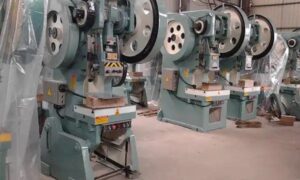
During each press stroke, the ram moves vertically, allowing the punch and die to shape or cut sheet metal with high accuracy and repeatable force.
Mechanical punch presses are widely used for processing materials such as carbon steel、stainless steel、aluminum、copper、brass and are suitable for both small precision parts and high-volume production.
Their combination of speed, reliability, and durability makes them one of the most popular metal stamping machines in modern manufacturing.
How Does a Mechanical Punch Press Work?
The working principle of a mechanical punch press is based on converting rotary motion into linear motion.
An electric motor continuously rotates the flywheel, storing kinetic energy while the machine is idle. When the clutch is engaged, the stored energy is transferred to the crankshaft, which drives the connecting rod and moves the ram downward.
The punch attached to the ram presses against the die, completing operations such as punching、blanking、forming、bending、cutting. After reaching the bottom of the stroke, the crank mechanism returns the ram to its original position, preparing the machine for the next production cycle.
Because this motion is entirely mechanical, the machine delivers stable and repeatable performance even during long production runs.
Mechanical Punch Press Mechanism
The transmission mechanism is the heart of every mechanical punch press. It determines how efficiently power is transferred from the motor to the tooling.
The complete motion sequence follows a simple path:
Motor → Flywheel → Clutch → Crankshaft → Connecting Rod → Ram → Punch and Die
Each component performs a specific function to ensure smooth movement and accurate stamping.
The flywheel stores energy, the clutch controls power transmission, the crankshaft converts rotary motion into reciprocating movement, and the connecting rod transfers that movement to the ram.
Together, these components provide stable operation, accurate positioning, high production efficiency, and long service life.
Mechanical Punch Press Crank-Slider Mechanism
The crank-slider mechanism is the most important motion system inside a mechanical punch press.
As the crankshaft rotates continuously, the connecting rod converts circular motion into the vertical movement of the ram. This simple yet highly efficient mechanism enables the machine to perform repeated stamping cycles with excellent consistency.
Compared with more complex drive systems, the crank-slider mechanism offers several advantages, including high transmission efficiency, stable operation, easy maintenance, and reliable long-term performance.
Because of its durability and precision, this mechanism is widely used in both standard and high-speed mechanical punch presses.
Mechanical Punch Press Transmission System
A reliable transmission system ensures that the machine delivers consistent stamping force throughout production.
The transmission system generally consists of the electric motor、flywheel、clutch、gear system、crankshaft.
The motor supplies continuous power, while the flywheel stores energy and releases it during each working stroke. The clutch connects and disconnects power as required, allowing precise control of the stamping cycle.
A well-designed transmission system improves production efficiency, minimizes vibration, and extends the operating life of critical mechanical components.
Mechanical Punch Press Lubrication and Cooling System
Although the stamping operation itself is fast, continuous production generates friction and heat inside the machine.
The lubrication system reduces wear between moving parts, ensuring smooth movement of bearings, gears, guide rails, and other mechanical components.
Regular lubrication helps improve machine efficiency, reduce maintenance costs, prevent premature component wear, and extend overall equipment life.
Many modern mechanical punch presses also include cooling systems that help maintain stable operating temperatures during long production runs. Effective cooling improves reliability and reduces the risk of thermal deformation.
Mechanical Punch Press Motion Simulation
Modern manufacturers increasingly use three-dimensional simulation software when designing a mechanical punch press.
Motion simulation allows engineers to evaluate the complete operating cycle before the machine is manufactured.
Engineers can analyze factors such as movement trajectory、component interference、force distribution、stress concentration、machine stability to identify potential design issues at an early stage.
By optimizing these parameters, manufacturers can improve stamping accuracy, reduce vibration, extend equipment life, and increase production efficiency.
Simulation technology also shortens development time while reducing manufacturing costs.
Mechanical Punch Press Applications
Because of its high productivity and stable performance, the mechanical punch press is suitable for numerous metalworking operations.
Typical applications include punching、blanking、cutting、forming、bending、embossing, while common products include automotive brackets、electrical enclosures、household appliance parts、hardware accessories、electronic components and many other precision metal parts.
Mechanical punch presses are especially suitable for medium- and high-volume production where consistent quality and fast cycle times are essential.
Mechanical Punch Press Safety Operation
Safe operation is one of the most important aspects of using a mechanical punch press.
Before starting production, operators should carefully inspect the electrical system, lubrication system, transmission components, cooling system, and all safety devices to ensure that the machine is operating normally.
Protective guards, emergency stop switches, and safety controls should always remain functional during production. Operators should never place their hands inside the die area while the machine is running and should always stop the machine before changing tooling or performing maintenance.
During operation, it is important to monitor machine performance continuously. Unusual vibration, abnormal noise, unstable stamping quality, or excessive heat may indicate mechanical problems that require immediate inspection.
Maintaining a clean working environment and following standardized operating procedures not only improves production efficiency but also significantly reduces the risk of workplace accidents.
Mechanical Punch Press Maintenance Tips
Routine maintenance is essential for maintaining the performance of a mechanical punch press.
Daily inspections should focus on key components such as the crankshaft, connecting rod, bearings, guide rails, clutch, flywheel, lubrication system, and electrical controls.
Proper lubrication reduces friction and prevents excessive wear, while regular cleaning removes dust and metal debris that may affect machine accuracy.
Tooling should also be inspected frequently. Worn punches and dies can reduce product quality, increase stamping force, and shorten equipment life if not replaced promptly.
A preventive maintenance schedule helps minimize downtime, lower repair costs, and ensure long-term production stability.
Conclusion
A mechanical punch press remains one of the most efficient and reliable machines for modern sheet metal manufacturing. Its crank-slider mechanism, robust transmission system, and precise mechanical movement allow manufacturers to perform high-speed stamping with excellent accuracy and consistency.
Whether producing automotive components、electrical parts、hardware products、appliance components、precision sheet metal parts, a mechanical punch press offers dependable performance for a wide range of industrial applications.
By understanding its working principle, selecting the appropriate tooling, following proper operating procedures, and carrying out regular maintenance, manufacturers can improve production efficiency, extend machine life, reduce operating costs, and achieve consistently high-quality stamping results.

