
A punch press is one of the most important machines in modern sheet metal fabrication. It uses a punch and die system to cut, shape, and form metal sheets through high-pressure stamping operations. From automotive components to electrical equipment, punch presses provide efficient and reliable solutions for large-scale metal production.
At IVILA, we provide professional sheet metal machinery and tooling solutions designed to improve production efficiency, product accuracy, and manufacturing stability. This guide explains what a punch press is, how it works, its main types, applications, and maintenance methods.
What Is a Punch Press?
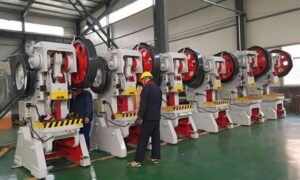
A punch press is a metal forming machine that uses a punch and die to apply pressure to sheet metal and create the required shape. Unlike traditional machining methods, punch presses form parts through stamping without removing large amounts of material.
A typical punch press consists of a machine frame, ram, drive system, control system, and stamping die. By installing different dies, the machine can perform various operations such as punching、blanking、piercing、bending、forming、trimming、embossing and drawing.
Because of its high production speed, excellent repeatability, and low processing cost, a punch press is widely used in modern manufacturing.
Main Types of Punch Press
Punch presses can be classified according to their driving systems, including mechanical punch presses, hydraulic punch presses, and pneumatic punch presses.
Mechanical Punch Press
A mechanical punch press uses a motor, flywheel, crankshaft, and connecting rod system to convert rotary motion into vertical movement of the ram.
The main advantages of mechanical punch presses include high production speed, stable operation, accurate repeatability, and low operating costs.
They are commonly used for mass production applications such as automotive components、electronic parts、metal brackets and hardware products.
Hydraulic Punch Press
A hydraulic punch press generates pressing force through hydraulic cylinders. Compared with mechanical models, hydraulic presses can maintain consistent force throughout the entire stroke.
The advantages of hydraulic punch presses include adjustable pressure, smooth operation, strong forming capability, and suitability for thicker materials.
They are widely used for applications requiring higher forming force, such as large metal structures、heavy sheet processing、deep drawing parts and industrial components.
Pneumatic Punch Press
A pneumatic punch press uses compressed air to drive the ram. It is usually designed for lightweight and high-speed stamping operations.
Due to its simple structure, easy maintenance, and fast working speed, pneumatic punch presses are suitable for precision stamping applications such as electronic components、small metal parts、thin sheet products and customized hardware.
How Does a Punch Press Work?
The working principle of a punch press is based on the cooperation between the punch and die.
During operation, the drive system moves the ram downward, causing the punch to press the sheet metal into the die. The material is then cut or formed into the required shape.
The basic working process includes material positioning, punch movement, metal forming, part separation, and ram return.
The final product quality depends on many factors, including punch press accuracy, stamping die design, material properties, and production parameters.
A high-precision stamping die is especially important because it directly affects dimensional accuracy, surface quality, and tool life.
Common Applications of Punch Press Machines
Punch presses are widely used in industries that require efficient sheet metal production.
Typical applications include automotive parts、electrical enclosures、home appliance components、industrial equipment、electronic products and construction hardware.
Common stamping processes performed by punch presses include punching、blanking、bending、forming、drawing and trimming.
With the increasing demand for lightweight and precision metal components, punch presses continue to play an important role in automotive manufacturing, electronics production, and industrial fabrication.
Factors Affecting Punch Press Performance
The performance of a punch press depends on the complete stamping system rather than the machine alone.
The stamping die is one of the most important factors. A precision stamping die helps maintain stable production, reduce burrs, minimize deformation, and extend tool life.
Machine accuracy is also critical. Press capacity, stroke stability, operating speed, and control system performance directly influence production consistency.
Material selection also affects stamping results. Different materials have different strength, hardness, and forming characteristics. Proper material matching can reduce problems such as cracking, wrinkling, and excessive springback.
Optimizing the combination of punch press, stamping die, and material is the key to achieving efficient production.
Safe Operation of Punch Press
Proper operation procedures are essential for maintaining safety and production efficiency.
Before starting production, operators should check machine condition, lubrication status, die installation, and safety protection systems.
During operation, the working area should remain clean, and operators should avoid placing hands near the die area. Proper feeding tools should be used when handling materials.
Regular training and correct operating methods help prevent accidents and improve production stability.
Punch Press Maintenance Tips
Regular maintenance is necessary to keep a punch press working efficiently.
Daily maintenance should include cleaning metal chips, checking lubrication systems, inspecting abnormal noise or vibration, and maintaining machine cleanliness.
Manufacturers should also regularly inspect transmission components, guide systems, electrical systems, hydraulic or pneumatic components, and stamping die conditions.
Proper maintenance helps reduce unexpected downtime, improve machine reliability, and extend equipment service life.
How to Choose the Right Punch Press?
Choosing the correct punch press depends on production requirements, material characteristics, and product complexity.
Important factors include required punching force, material thickness, production volume, product accuracy, automation level, and after-sales support.
A reliable manufacturer should provide not only high-quality equipment but also technical assistance, spare parts support, and long-term service.
Selecting the right punch press can help manufacturers reduce operating costs and improve production efficiency.
Why Choose IVILA Punch Press Solutions?
IVILA provides professional sheet metal machinery and tooling solutions for global manufacturing industries.
Our punch press solutions feature strong machine structures, stable performance, high production accuracy, durable components, customized configurations, and professional technical support.
Combined with high-quality stamping dies and complete after-sales service, IVILA helps customers achieve reliable and efficient metal fabrication.
Conclusion
A punch press is an essential machine in modern sheet metal fabrication. Understanding its types, working principles, applications, and maintenance methods helps manufacturers improve production efficiency and maintain consistent product quality.
By combining a reliable punch press with precision stamping dies, suitable materials, and proper maintenance practices, companies can reduce production costs, extend equipment life, and achieve long-term manufacturing success.

