
Punch Press Working Principle and Detailed Structure: A Complete Guide for Metal Stamping
Meta Description: Learn the punch press working principle, machine structure, major components, and applications. Discover how punch presses achieve efficient and precise sheet metal stamping.
What Is a Punch Press?
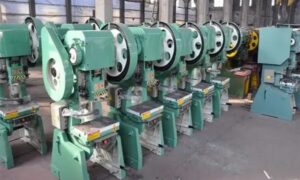
A punch press is one of the most widely used machines in the sheet metal manufacturing industry. It is designed to cut, shape, and form metal sheets by applying tremendous force through a punch and die set. Whether producing automotive body panels, electrical cabinets, household appliance components, or precision electronic parts, punch presses provide fast, accurate, and repeatable production.
Unlike machining processes that remove material with cutting tools, a punch press forms metal by applying pressure. Depending on the tooling design, the machine can perform punching, blanking, bending, embossing, coining, and deep drawing while maintaining excellent dimensional consistency.
Because of its high production efficiency and low manufacturing cost, the punch press has become an essential piece of equipment in modern metal fabrication workshops.
How Does a Punch Press Work?
The working principle of a punch press is relatively simple but highly efficient. The machine converts the rotary motion produced by the motor into the vertical movement required for stamping operations.
After the motor starts, it continuously rotates the flywheel, which stores kinetic energy. When the clutch engages, this energy is transmitted through the gear system to the crankshaft. The crankshaft and connecting rod then convert the rotary motion into the up-and-down movement of the slide (also called the ram).
As the slide moves downward, the upper die presses the sheet metal against the lower die. Depending on the tooling design, the material may be cut, bent, stretched, or formed into the desired shape. Once the operation is completed, the slide returns to its original position and the next stamping cycle begins.
This continuous motion allows punch presses to achieve extremely high production speeds while maintaining excellent precision.
Main Components of a Punch Press
Although punch presses are available in many sizes and configurations, their basic structure is very similar. Each component plays an important role in ensuring smooth operation and accurate stamping.
Machine Frame
The frame is the foundation of the entire machine. It supports all mechanical components and absorbs the enormous reaction forces generated during stamping. A rigid frame helps reduce vibration and improves machining accuracy.
Flywheel and Drive System
The flywheel stores energy generated by the electric motor. Instead of requiring the motor to produce maximum force during every stroke, the flywheel releases stored energy whenever the clutch engages. This design greatly improves energy efficiency and production stability.
Slide (Ram)
The slide is the moving part of the punch press. It travels vertically and carries the upper die. The accuracy of the slide directly affects the quality of every stamped part.
Worktable
The worktable supports the lower die and the sheet metal during production. It must remain flat and rigid to ensure precise alignment between the upper and lower tooling.
Understanding the Punch Press Die Structure
The die is often considered the “heart” of a punch press because it determines the final shape of the workpiece. Even the most advanced punch press cannot produce high-quality parts without precision tooling.
The upper die is mounted on the slide and moves together with the ram during each stamping cycle. The lower die is fixed on the machine table and supports the material throughout the forming process.
Between the upper and lower dies are several important components, including guide posts, guide bushes, stripper plates, positioning pins, and pressure plates. These parts ensure that the tooling remains accurately aligned, the material stays in the correct position, and the finished workpiece can be removed smoothly after stamping.
Proper die clearance is particularly important. If the clearance between the punch and die is too small, excessive wear may occur. If the clearance is too large, burrs and poor edge quality may result.
Different Types of Punch Presses
Punch presses can be classified according to their driving systems. The three most common types are mechanical punch presses, hydraulic punch presses, and pneumatic punch presses.
Mechanical punch presses are the most popular choice for high-volume manufacturing because they provide fast production speeds and excellent repeatability. They are widely used for continuous stamping operations in industries such as automotive and electronics.
Hydraulic punch presses generate force using hydraulic cylinders instead of crank mechanisms. They offer adjustable pressure and are particularly suitable for deep drawing and heavy-duty forming applications where greater flexibility is required.
Pneumatic punch presses use compressed air to drive the slide. Although they produce lower forming forces, they are simple to operate, easy to maintain, and commonly used for light stamping work.
Where Are Punch Presses Used?
Thanks to their versatility, punch presses are found in almost every sheet metal manufacturing industry.
In automotive production, they manufacture body panels, brackets, reinforcements, and structural components. Electronics manufacturers use punch presses to produce computer chassis, electrical enclosures, and connector parts. Home appliance factories rely on punch presses for washing machine panels, refrigerator components, and kitchen equipment.
Hardware manufacturers also use punch presses to produce hinges, fasteners, mounting brackets, and many other metal accessories in large quantities.
How to Maintain a Punch Press
Routine maintenance is one of the most effective ways to extend the service life of a punch press and reduce unexpected downtime.
Operators should inspect the lubrication system before starting the machine each day and ensure that the clutch, brake, and electrical systems are functioning correctly. Regular inspection of the dies, guide posts, and fasteners also helps maintain production accuracy.
In addition, periodic professional maintenance can identify wear before it develops into costly machine failures. Keeping the machine clean and properly lubricated is equally important for long-term reliability.
How to Choose the Right Punch Press
Selecting the right punch press depends on several production factors, including material thickness, required stamping force, production volume, and tooling compatibility.
Manufacturers producing high volumes of identical parts usually prefer mechanical punch presses because of their speed and efficiency. For applications involving thick materials or complex forming operations, hydraulic punch presses are often a better choice.
It is also important to choose a reliable supplier that can provide quality machinery, technical support, spare parts, and professional after-sales service. A well-built punch press combined with precision tooling will deliver better productivity and lower operating costs throughout its service life.
Conclusion
The punch press remains one of the most important machines in modern sheet metal fabrication. By converting rotary motion into powerful vertical movement, it performs a wide range of metal stamping operations with exceptional speed and accuracy.
Understanding the working principle, machine structure, and major components of a punch press not only helps improve production efficiency but also makes equipment selection, maintenance, and troubleshooting much easier. Whether used in automotive manufacturing, electronics production, or general metal fabrication, a properly maintained punch press continues to be a reliable solution for high-quality metal stamping.

