
In modern sheet metal fabrication, surface quality has become just as important as bending accuracy. For applications involving stainless steel, aluminum, copper, and aerospace components, even small scratches or visible tooling marks can affect the appearance, performance, and final value of a part.
Traditional press brake bending often leaves pressure marks or scratches on the workpiece. These marks are mainly caused by the contact and friction between the sheet metal and the shoulders of the V-die during bending. For parts with strict surface-quality requirements, these defects may lead to additional finishing work or even part rejection.
Fortunately, several tooling and process solutions can significantly reduce or eliminate bending marks. This article introduces four practical solutions for achieving cleaner, more consistent, and nearly mark-free press brake bending.
Why Do Bending Marks Appear?
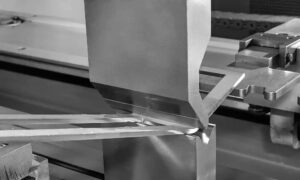
During conventional V-die bending, the sheet metal moves against the shoulders of the lower die as the punch presses the material into the V-opening. This movement creates pressure and friction between the sheet and the die.
The severity of bending marks is affected by several factors, including the V-opening width, shoulder radius, material type, sheet thickness, bending force, and tooling surface condition.
Two lower-die parameters are particularly important: the V-opening width and the shoulder radius.
V-Opening Width
For the same sheet thickness and upper punch, a larger V-opening generally reduces the pressure between the sheet and the shoulders of the V-die. Lower contact pressure means less friction, which can help reduce the depth of bending marks.
Therefore, when surface quality is important, selecting a slightly wider V-opening can be an effective way to reduce visible impressions.
However, the V-opening should still be selected according to the material thickness, bending angle, required inside radius, and machine capacity. Simply choosing the largest possible opening is not always the best solution.
Lower Die Shoulder Radius
The shoulder radius of the V-die also has a direct effect on surface marks.
A larger shoulder radius distributes the bending pressure over a larger contact area and reduces localized pressure between the sheet and the die. As a result, the risk of deep impressions and scratches can be reduced.
For surface-sensitive materials such as stainless steel, aluminum, and pre-finished sheets, a lower die with a properly selected shoulder radius is often preferable to a sharp-edged V-die.
In practice, choosing the right V-opening and shoulder radius should be the first step before considering specialized mark-free tooling.
4 Solutions for Mark-Free Press Brake Bending
When conventional tooling cannot provide the required surface quality, manufacturers can use specialized solutions. The four common approaches include mark-free protective film, non-metallic V-dies, rotary dies, and roller-style V-dies.
1. Mark-Free Protective Film
A protective bending film is one of the simplest and most economical solutions for reducing press brake tooling marks.
The film is placed between the sheet metal and the lower die. It acts as a buffer layer, preventing direct metal-to-metal contact and reducing the friction coefficient between the workpiece and the die shoulder.
During bending, the protective film helps distribute contact pressure and prevents the sharp edges or hardened surfaces of the die from directly damaging the sheet.
Advantages of Protective Bending Film
The main advantages are its low cost, easy installation, and flexibility.
It is particularly useful for:
- Stainless steel sheets
- Aluminum sheets
- Copper sheets
- Decorative or pre-finished panels
- Parts with strict appearance requirements
The film can be placed directly over the lower die before bending. Once the bending operation is complete, it can be removed or replaced as required.
For manufacturers that occasionally process surface-sensitive materials, protective film can be a practical alternative to investing in a complete set of specialized tooling.
However, the film is a consumable material. Its durability depends on sheet thickness, material, bending force, production volume, and tooling condition.
2. Non-Metallic V-Dies
Another effective solution is to use a V-die made with a softer non-metallic material.
Instead of allowing the metal sheet to directly contact a hardened steel die, the contact surface can be made from materials such as polyurethane or nylon. Because these materials are softer than the workpiece, they can significantly reduce the risk of scratching and indentation.
Non-metallic V-dies are especially suitable for thin aluminum and other easily marked materials.
For example, polyurethane and high-strength nylon tooling can be used for certain thin-sheet applications where surface appearance is more important than extremely high bending loads.
Benefits of Non-Metallic Tooling
Non-metallic V-dies can provide:
- Lower contact pressure
- Reduced surface scratching
- Reduced bending marks
- Better protection for coated materials
- Improved appearance of finished parts
The main limitation is load capacity. Non-metallic tooling should be selected according to the sheet thickness, material strength, bending length, and required bending force.
For heavy-duty bending, conventional hardened steel tooling may still be necessary.
3. Rotary Die Tooling
Rotary tooling provides a more advanced solution for reducing bending marks.
Unlike a conventional fixed V-die, a rotary die uses movable rollers or rotating contact surfaces. During bending, the contact surface rotates as the sheet moves, replacing much of the sliding friction with rolling friction.
This is an important difference.
With a conventional V-die, the sheet slides across the die shoulders during bending. With a rotary system, the rollers move with the material, greatly reducing relative sliding between the workpiece and the tooling.
How Rotary Tooling Works
As the punch moves downward, the sheet is pressed into the lower tooling. The rotating components on both sides of the V-opening move with the sheet and support the material during forming.
This design reduces localized friction and distributes the bending load more smoothly.
As a result, rotary tooling can significantly reduce visible marks on the outer surface of the workpiece.
Advantages of Rotary Dies
Rotary press brake tooling offers several benefits:
- Reduced bending marks
- Lower sliding friction
- Better surface protection
- Improved performance on short flanges
- Greater flexibility for special bending geometries
- Good repeatability
- Long tooling life when properly maintained
- Easy cleaning and maintenance
- High precision for demanding applications
Rotary tooling can also be useful when bending parts with holes or slots close to the bending line because the reduced sliding movement helps minimize deformation around these features.
Another advantage is that certain rotary die designs can accommodate different material thicknesses, reducing the need for frequent tooling changes.
4. Roller-Style Adjustable V-Die
A roller-style adjustable V-die is another solution based on the same fundamental principle: replace sliding friction with rolling contact.
In a conventional V-die, the sheet slides over the shoulders of the die. This sliding movement creates friction and can leave visible marks.
A roller-style V-die uses hardened rollers at the contact points. As the workpiece moves during bending, the rollers rotate accordingly.
This greatly reduces sliding friction between the sheet and the lower die.
Why Rolling Contact Reduces Bending Marks
The difference between sliding and rolling contact is particularly important for high-quality surface bending.
With sliding contact, the sheet and die surfaces move against each other. The combination of pressure and friction can create scratches and impressions.
With rolling contact, the relative sliding movement is significantly reduced. The force is distributed through the rotating contact surface, which helps protect the sheet from damage.
This makes roller-style tooling especially useful for stainless steel, aluminum, coated sheets, and other appearance-sensitive materials.
How to Choose the Right Mark-Free Bending Solution?
Different applications require different approaches. There is no single tooling solution that works best for every sheet metal bending operation.
For occasional bending of surface-sensitive materials, protective film is usually the simplest and most economical choice.
For thin sheets and applications requiring very gentle contact, non-metallic V-dies can provide excellent surface protection.
For demanding production applications where both surface quality and bending efficiency are important, rotary dies or roller-style V-dies are more suitable.
The choice should take into account:
- Sheet material
- Sheet thickness
- Bending length
- Required bending angle
- Inside bending radius
- Surface finish
- Production volume
- Required dimensional accuracy
- Bending force
- Tooling life
- Machine configuration
Mark-Free Bending Is More Than Just Choosing a Die
Although specialized tooling can greatly reduce bending marks, tooling selection is only one part of the process.
Correct setup is equally important.
The operator should ensure that the upper punch and lower die are properly aligned and that the tooling surfaces are clean and free from chips or metal debris. The correct V-opening and shoulder radius should also be selected according to the material and thickness.
Excessive bending force should be avoided when possible, especially when processing thin or highly finished sheets.
For high-precision production, it is also useful to perform a bending test before starting mass production. A test piece can help determine whether the selected tooling, V-opening, radius, and bending parameters can achieve the required surface quality.
The Benefits of Mark-Free Bending
Reducing bending marks can provide benefits beyond appearance.
When surface defects are minimized, manufacturers can reduce polishing, grinding, repainting, or other secondary finishing operations. This can shorten production time and reduce labor costs.
At the same time, fewer rejected parts mean better material utilization and improved production efficiency.
For industries such as elevators, stainless steel fabrication, kitchen equipment, architectural metalwork, electronics, automotive components, and aerospace manufacturing, these improvements can have a significant impact on overall production costs.
Final Thoughts
Mark-free press brake bending is becoming increasingly important as customers demand higher surface quality and tighter manufacturing standards.
The basic principle is simple: reduce the pressure and friction between the sheet metal and the lower tooling.
A properly selected V-opening and larger shoulder radius can reduce marks during conventional bending. When additional protection is required, manufacturers can choose protective bending film, non-metallic V-dies, rotary dies, or roller-style adjustable V-dies.
Among these solutions, rotary and roller-style tooling can provide particularly effective surface protection because they reduce sliding friction and replace it with rolling contact.
For manufacturers handling stainless steel, aluminum, copper, coated sheets, and other appearance-sensitive materials, selecting the right press brake tooling can make a significant difference in final product quality.
With the right tooling design, bending parameters, and machine setup, it is possible to achieve cleaner surfaces, fewer rejected parts, lower finishing costs, and more efficient sheet metal production.
If you are looking for suitable press brake tooling for mark-free bending, IVILA can provide tooling solutions based on your machine model, material, thickness, bending angle, and application requirements. Bending tests can also be used to verify the tooling performance before production.

